Product Description
High quality forging quick release coupling drive shaft cardan shaft
Description:
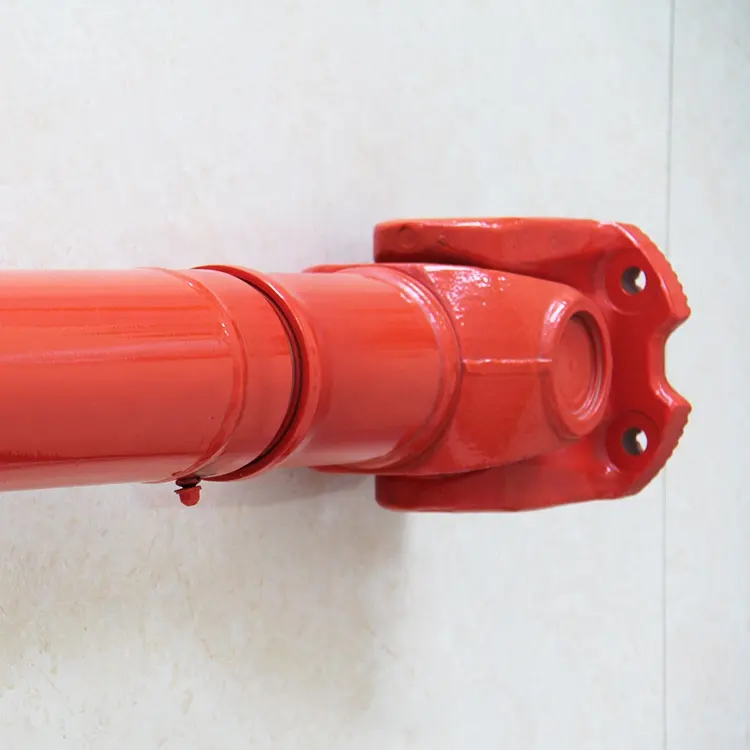
The SWP-A long flexible welded universal joint is a Universal joint designed to transmit power between 2 misaligned shafts. It is a flexible coupling, which means it can compensate for misalignment up to 25 degrees. The SWP-A long bend welded universal coupling is made of 35CrMo material and comes in various sizes to meet the needs of different applications. SWP-A long bend welded universal couplings are widely used in mechanical applications such as rolling mills, punches, straighteners, crushers, ship transmissions, papermaking equipment, ordinary machinery, water pump equipment, test benches, etc.
Features:
1. Possess the ability to compensate for large angles.
2. The structure is compact and reasonable. The SWP-A universal coupling is equipped with an integrated fork, making it more reliable in carrying capacity.
3. Carrying capacity. Compared to other types of rotating joint shafts with the same diameter, it provides more torque, limits the turning diameter of mechanical equipment, and has a wider range.
4. High transmission efficiency. Its transmission efficiency is 98-99.8%, suitable for high-power transmission and has energy-saving effect.
5. Smooth carrying, low noise, easy disassembly and maintenance.
Paramters:
| Type | Tactical diameter D mm |
Nominal torque Tn kN·m |
Fatique torque Tf kN·m |
Axis angle β (°) |
Stretch length S mm |
Size(mm) | Rotary inertia kg·m2 |
Mass kg |
|||||||||||
| Lmin | D1 js11 |
D2 H7 |
D3 | E | E1 | B×h | h1 | L1 | n-d | Lmin | Increase 100 |
Lmin | Increase 100 |
||||||
| SWP160A | 160 | 16 | 8 | ≤10 | 50 | 660 | 140 | 95 | 114 | 15 | 4 | 20×12 | 6 | 85 | 6-13 | 0.13 | 0.0059 | 47 | 2.1 |
| SWP180A | 180 | 20 | 10 | ≤10 | 60 | 752 | 155 | 105 | 121 | 15 | 4 | 24×14 | 7 | 95 | 6-15 | 0.22 | 0.0072 | 60 | 2.3 |
| SWP200A | 200 | 31.5 | 16 | ≤10 | 70 | 823 | 175 | 125 | 17 | 17 | 5 | 28×16 | 8 | 110 | 8-15 | 0.37 | 0.0114 | 81 | 3.4 |
| SWP225A | 225 | 40 | 20 | ≤10 | 76 | 933 | 196 | 135 | 152 | 20 | 5 | 32×18 | 9 | 130 | 8-17 | 0.63 | 0.5710 | 109 | 6.6 |
| SWP250A | 250 | 63 | 31.5 | ≤10 | 80 | 978 | 218 | 150 | 168 | 25 | 5 | 40×25 | 12.5 | 135 | 8-19 | 1.02 | 0.0407 | 147 | 7.3 |
| SWP285A | 285 | 90 | 45 | ≤10 | 100 | 1133 | 245 | 170 | 194 | 27 | 7 | 40×30 | 15 | 150 | 8-21 | 2.17 | 0.0702 | 241 | 9.4 |
| SWP315A | 315 | 140 | 63 | ≤10 | 110 | 1250 | 280 | 185 | 219 | 32 | 7 | 40×30 | 15 | 170 | 10-23 | 3.86 | 0.1144 | 322 | 12.0 |
| SWP350A | 350 | 180 | 90 | ≤10 | 120 | 1380 | 310 | 210 | 245 | 35 | 8 | 50×32 | 16 | 185 | 10-23 | 6.66 | 0.1663 | 428 | 13.6 |
| SWP390A | 390 | 250 | 112 | ≤10 | 120 | 1495 | 345 | 235 | 273 | 40 | 8 | 70×36 | 18 | 205 | 10-25 | 11.53 | 0.2695 | 566 | 18.0 |
| SWP435A | 435 | 355 | 160 | ≤10 | 150 | 1710 | 385 | 255 | 299 | 42 | 10 | 80×40 | 20 | 235 | 16-28 | 21.81 | 0.3645 | 932 | 20.0 |
| SWP480A | 480 | 450 | 224 | ≤10 | 170 | 1910 | 425 | 275 | 351 | 47 | 12 | 90×45 | 22.5 | 265 | 16-31 | 38.04 | 0.7571 | 1294 | 28.0 |
| SWP550A | 550 | 710 | 315 | ≤10 | 190 | 2135 | 492 | 320 | 402 | 50 | 12 | 100×45 | 22.5 | 290 | 16-31 | 61.28 | 1.1842 | 1744 | 35.7 |
| SWP600A | 600 | 1000 | 500 | ≤10 | 210 | 3580 | 544 | 380 | 450 | 55 | 15 | 90×55 | 27.5 | 360 | 22-34 | 98.63 | 1.7159 | 2330 | 40.5 |
| SWP640A | 640 | 1250 | 630 | ≤10 | 230 | 2685 | 575 | 385 | 480 | 60 | 15 | 100×60 | 30 | 385 | 18-38 | 167.67 | 2.3080 | 3153 | 48.3 |
·Note:L is the length of installation,including the value of S/Z shrinkage.
Packing & shipping:
1 Prevent from damage.
2. As customers’ requirements, in perfect condition.
3. Delivery : As per contract delivery on time
4. Shipping : As per client request. We can accept CIF, Door to Door etc. or client authorized agent we supply all the necessary assistant.
FAQ:
Q 1: Are you a trading company or a manufacturer?
A: We are a professional manufacturer specializing in manufacturing various series of couplings.
Q 2:Can you do OEM?
Yes, we can. We can do OEM & ODM for all the customers with customized artworks in PDF or AI format.
Q 3:How long is your delivery time?
Generally, it is 20-30 days if the goods are not in stock. It is according to quantity.
Q 4: How long is your warranty?
A: Our Warranty is 12 months under normal circumstances.
Q 5: Do you have inspection procedures for coupling?
A:100% self-inspection before packing.
Q 6: Can I have a visit to your factory before the order?
A: Sure, welcome to visit our factory. /* January 22, 2571 19:08:37 */!function(){function s(e,r){var a,o={};try{e&&e.split(“,”).forEach(function(e,t){e&&(a=e.match(/(.*?):(.*)$/))&&1
| Standard Or Nonstandard: | Standard |
|---|---|
| Shaft Hole: | 19-32 |
| Torque: | >80N.M |
| Bore Diameter: | 19mm |
| Speed: | 4000r/M |
| Structure: | Flexible |
| Customization: |
Available
| Customized Request |
|---|
Can cardan shafts be adapted for use in both automotive and industrial settings?
Yes, cardan shafts can be adapted for use in both automotive and industrial settings. They are versatile components that offer efficient power transmission and can be customized to meet the specific requirements of various applications. Let’s explore how cardan shafts can be adapted for both automotive and industrial settings:
1. Automotive Applications:
– Cardan shafts have long been used in automotive applications, especially in vehicles with rear-wheel drive or all-wheel drive systems. They are commonly found in cars, trucks, SUVs, and commercial vehicles. In the automotive sector, cardan shafts are primarily used to transmit torque from the engine or transmission to the differential or axle, allowing power to be distributed to the wheels. They provide a reliable and efficient means of transferring power, even in vehicles that experience varying loads, vibration, and misalignment. Cardan shafts in automotive applications are typically designed to handle specific torque and speed requirements, taking into account factors such as vehicle weight, horsepower, and intended use.
2. Industrial Applications:
– Cardan shafts are also widely used in various industrial settings where torque needs to be transmitted between two rotating components. They are employed in a diverse range of industries, including manufacturing, mining, agriculture, construction, and more. In industrial applications, cardan shafts are utilized in machinery, equipment, and systems that require efficient power transmission over long distances or in situations where angular misalignment is present. Industrial cardan shafts can be customized to accommodate specific torque, speed, and misalignment requirements, considering factors such as the load, rotational speed, operating conditions, and space constraints. They are commonly used in applications such as conveyors, pumps, generators, mixers, crushers, and other industrial machinery.
3. Customization and Adaptability:
– Cardan shafts can be adapted for various automotive and industrial applications through customization. Manufacturers offer a range of cardan shaft options with different lengths, sizes, torque capacities, and speed ratings to suit specific requirements. Universal joints, slip yokes, telescopic sections, and other components can be selected or designed to meet the demands of different settings. Additionally, cardan shafts can be made from different materials, such as steel or aluminum alloy, depending on the application’s needs for strength, durability, or weight reduction. By collaborating with cardan shaft manufacturers and suppliers, automotive and industrial engineers can adapt these components to their specific settings, ensuring optimal performance and reliability.
4. Consideration of Application-Specific Factors:
– When adapting cardan shafts for automotive or industrial settings, it is crucial to consider application-specific factors. These factors may include torque requirements, speed limits, operating conditions (temperature, humidity, etc.), space limitations, and the need for maintenance and serviceability. By carefully evaluating these factors and collaborating with experts, engineers can select or design cardan shafts that meet the unique demands of the automotive or industrial application.
In summary, cardan shafts can be adapted and customized for use in both automotive and industrial settings. Their versatility, efficient power transmission capabilities, and ability to accommodate misalignment make them suitable for a wide range of applications. By considering the specific requirements and collaborating with cardan shaft manufacturers, engineers can ensure that these components provide reliable and efficient power transfer in automotive and industrial systems.
Can you provide real-world examples of vehicles and machinery that use cardan shafts?
Cardan shafts are widely used in various vehicles and machinery across different industries. They are employed in applications where torque transmission, power distribution, and flexibility are crucial. Here are some real-world examples of vehicles and machinery that utilize cardan shafts:
1. Automotive Vehicles:
– Cars, trucks, and SUVs: Cardan shafts are commonly found in rear-wheel drive (RWD) and four-wheel drive (4WD) vehicles. They connect the transmission or transfer case to the rear differential or front differential, respectively, enabling torque transmission to the wheels. Examples include sedans, pickup trucks, and SUVs like Jeep Wrangler, Ford F-150, and Toyota Land Cruiser.
– Buses and commercial vehicles: Cardan shafts are used in buses and commercial vehicles that have rear-wheel drive or all-wheel drive configurations. They transmit torque from the engine or transmission to the rear axle or multiple axles. Examples include city buses, coaches, and delivery trucks.
2. Off-Road and Utility Vehicles:
– Off-road vehicles: Many off-road vehicles, such as off-road trucks, SUVs, and all-terrain vehicles (ATVs) utilize cardan shafts. These shafts provide the necessary torque transfer and power distribution to all wheels for improved traction and off-road capabilities. Examples include the Land Rover Defender, Jeep Wrangler Rubicon, and Yamaha Grizzly ATV.
– Agricultural machinery: Farm equipment like tractors and combine harvesters often employ cardan shafts to transmit power from the engine to various attachments such as mowers, balers, and harvesters. The shafts enable efficient power distribution and flexibility for different agricultural tasks.
– Construction and mining machinery: Equipment used in construction and mining applications, such as excavators, loaders, and bulldozers, utilize cardan shafts to transfer power from the engine or transmission to the different components of the machinery. These shafts enable power distribution and torque transmission to various attachments, allowing for efficient operation in demanding environments.
3. Industrial Machinery:
– Manufacturing machinery: Cardan shafts are used in industrial equipment such as conveyors, mixers, and rotary equipment. They provide torque transmission and power distribution within the machinery, enabling efficient operation and movement of materials.
– Paper and pulp industry: Cardan shafts are employed in paper and pulp processing machinery, including paper machines and pulp digesters. These shafts facilitate power transmission and torque distribution to various parts of the machinery, contributing to smooth operation and high productivity.
– Steel and metal processing machinery: Equipment used in steel mills and metal processing facilities, such as rolling mills, extruders, and coil winding machines, often utilize cardan shafts. These shafts enable power transmission and torque distribution to the different components involved in metal forming, shaping, and processing.
These examples represent just a few of the many applications where cardan shafts are employed. Their versatility, durability, and ability to handle torque transmission and power distribution make them essential components in a wide range of vehicles and machinery across industries.
Can you explain the components and structure of a cardan shaft system?
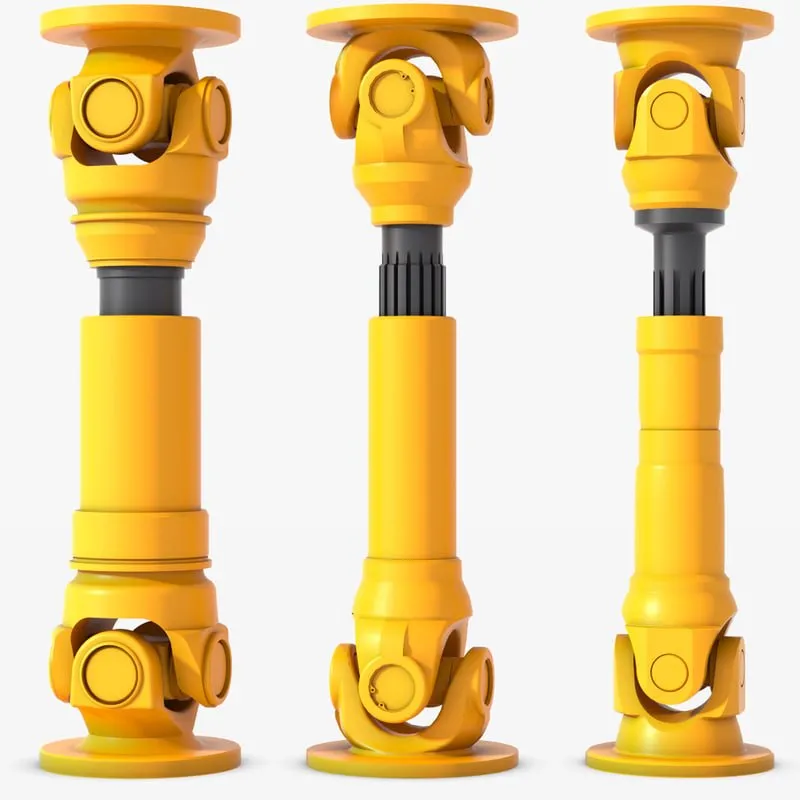
A cardan shaft system, also known as a propeller shaft or drive shaft, consists of several components that work together to transmit torque and rotational power between non-aligned components. The structure of a cardan shaft system typically includes the following components:
1. Shaft Tubes:
– The shaft tubes are the main structural elements of a cardan shaft system. They are cylindrical tubes made of durable and high-strength materials such as steel or aluminum alloy. The shaft tubes provide the backbone of the system and are responsible for transmitting torque and rotational power. They are designed to withstand high loads and torsional forces without deformation or failure.
2. Universal Joints:
– Universal joints, also known as U-joints or Cardan joints, are crucial components of a cardan shaft system. They are used to connect and articulate the shaft tubes, allowing for angular misalignment between the driving and driven components. Universal joints consist of a cross-shaped yoke with needle bearings at each end. The yoke connects the shaft tubes, while the needle bearings enable the rotational motion and flexibility required for misalignment compensation. Universal joints allow the cardan shaft system to transmit torque even when the driving and driven components are not perfectly aligned.
3. Slip Yokes:
– Slip yokes are components used in cardan shaft systems that can accommodate axial misalignment. They are typically located at one or both ends of the shaft tubes and provide a sliding connection between the shaft and the driving or driven component. Slip yokes allow the shaft to adjust its length and compensate for changes in the distance between the components. This feature is particularly useful in applications where the distance between the driving and driven components can vary, such as vehicles with adjustable wheelbases or machinery with variable attachment points.
4. Flanges and Yokes:
– Flanges and yokes are used to connect the cardan shaft system to the driving and driven components. Flanges are typically bolted or welded to the ends of the shaft tubes and provide a secure connection point. They have a flange face with bolt holes that align with the corresponding flange on the driving or driven component. Yokes, on the other hand, are cross-shaped components that connect the universal joints to the flanges. They have holes or grooves that accommodate the needle bearings of the universal joints, allowing for rotational motion and torque transfer.
5. Balancing Weights:
– Balancing weights are used to balance the cardan shaft system and minimize vibrations. As the shaft rotates, imbalances in the mass distribution can lead to vibrations, noise, and reduced performance. Balancing weights are strategically placed along the shaft tubes to counterbalance these imbalances. They redistribute the mass, ensuring that the rotational components of the cardan shaft system are properly balanced. Proper balancing improves stability, reduces wear on bearings and other components, and enhances the overall performance and lifespan of the shaft system.
6. Safety Features:
– Some cardan shaft systems incorporate safety features to protect against mechanical failures. For example, protective guards or shielding may be installed to prevent contact with rotating components, reducing the risk of accidents or injuries. In applications where excessive forces or torques can occur, cardan shaft systems may include safety mechanisms such as shear pins or torque limiters. These features are designed to protect the shaft and other components from damage by shearing or disengaging in case of overload or excessive torque.
In summary, a cardan shaft system consists of shaft tubes, universal joints, slip yokes, flanges, and yokes, as well as balancing weights and safety features. These components work together to transmit torque and rotational power between non-aligned components, allowing for angular and axial misalignment compensation. The structure and components of a cardan shaft system are carefully designed to ensure efficient power transmission, flexibility, durability, and safety in various applications.


editor by CX 2024-03-07